Building a Personalisation Roadmap on a Realistic Budget
Most personalisation projects don't fail because of budget. They fail because nobody sequenced the work properly. Here's a practical twelve-month plan, split into three phases, that builds real personalisation capability without a platform purchase, a new hire, or a six-figure investment.
 Tim Gaunt
"We'd love to do personalisation, but we don't have the budget."
I hear that on nearly every personalisation sales call. And most of the time, it isn't a budget problem at all. It's a sequencing problem.
People assume personalisation means a new platform, a data science hire, and a six-figure contract. It doesn't. Once setup, it can take as little as twenty minutes a month of proper attention, a willingness to start smaller than feels comfortable, and a plan that runs over twelve months rather than twelve weeks.
Here's the plan we walk clients through. Three phases, twelve months, no surprises.
Why phasing matters
Most personalisation projects fail because teams try to do everything at once. They buy the platform, commission the integrations, hire the agency, and then wonder six months later why nothing's moving. The technology isn't the problem. The order of operations is.
Phasing gives you two things that matter more than any piece of kit. You learn before you commit, and you build early wins that justify the next round of spend. By the time you're asking for budget to expand, you've already got numbers showing what the first phase delivered.
There's a political benefit too. Finance directors are far happier signing off £2,000 for a proof of concept than £50,000 for a platform nobody's tested yet.
Phase 1 (Months 1-3): Build the foundation
This phase is almost entirely free. The goal is clean data before you spend a penny on implementation.
Start with an audit of what you're tracking. Most sites have Google Analytics running, but it's rarely set up for personalisation properly. You want site search captured as events, category page interactions tracked, and a reliable way to identify returning visitors and logged-in customers. If any of that's missing or broken, fix it first. I wrote about why this matters in the cold start problem post. Skipping this step is the single biggest reason personalisation projects underperform.
Next, export six months of order history. Work out the average purchase intervals by customer type. Find your top 20 percent of customers by value. Map your audience into two or three broad groups: new visitor, returning customer, account holder. That's enough to start with. You don't need twelve segments on day one.
Finally, find your highest-traffic, lowest-converting pages. Those are your Phase 2 targets.
Cost for this phase is mostly internal time. If your platform is reasonably modern, you won't need any new tools.
Phase 2 (Months 4-6): First implementations
Now you've got data. Start using it.
Pick one homepage rule and ship it. Returning customers see categories based on their last visit. New visitors see best-sellers or seasonal ranges. That's it. You're not rebuilding the homepage, you're adding one layer of intelligence to it. It's a smaller version of the composite banner approach I covered in the death of the hero post.
Set up one email automation. Just one. The reorder nudge works well for most businesses because it's tied to a predictable purchase cycle. Run it for your most repeat-prone segment and measure for sixty days before you touch anything else in email.
Add an abandoned cart sequence. Three emails, three different messages, not three versions of "you forgot something." The framework in the win-back post will do the heavy lifting here.
Start reviewing zero-result searches once a month. A spreadsheet is fine. You'd be surprised how much revenue lives in that report.
For a mid-market site, Phase 2 usually lands in the £1,500-5,000 range for implementation, assuming your platform's already capable and you're using an email tool you already pay for. I'll caveat that. Costs vary enormously depending on platform and integration complexity, and I'd rather quote you properly than throw out a number that doesn't hold up.
Phase 3 (Months 7-12): Progressive enhancement
By now you've got baseline numbers from Phase 2. You know what's working, what isn't, and where the next gains live.
Add a second homepage segment. Geographic works well for retail, account type for B2B. Build out the email programme based on what Phase 2 taught you. The win-back sequence for lapsed customers is usually the next highest-value addition. Implement search personalisation so logged-in users see results weighted by their browsing history.
Act on the zero-result search data you've been collecting. Sometimes that means new products. Sometimes it means renaming a category because nobody searches for it the way you named it. Occasionally it's just a simple redirect.
Then set a quarterly review cadence. Not a discovery project, just a ninety-minute meeting where you look at the numbers, pick one thing to improve, and ship it before the next quarter.
Phase 3 usually takes another 5-10 days of dev time spread across the back half of the year. After that, ongoing effort is mostly internal review.
What this roadmap isn't
Let me be explicit about what you're not signing up for:
- It's not a £50,000 platform purchase
- It's not a new hire
- It's not a six-month discovery project before anything goes live
- It's not dependent on having "enough" data before you start. Phase 1 exists specifically to create that data
If anyone's quoting you a number that starts with five figures before they've seen your analytics, they're selling you a product, not a roadmap.
What to expect in return
Be honest with yourself about the curve.
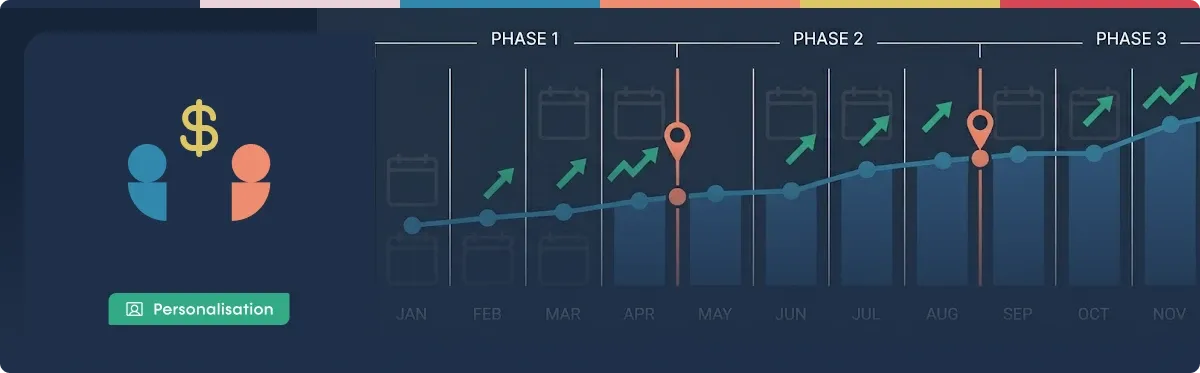
Months 1 to 3, you won't see direct return. You're laying foundations. That's the part everyone wants to skip, and it's the part that decides whether everything else works.
Months 4 to 6, you'll start seeing early signals. Reorder nudge conversion. Abandoned cart recovery. Small numbers, but measurable and attributable.
Months 7 to 12 is where the compounding kicks in. Average order value climbs. Conversion rate lifts on targeted segments. Repeat purchase rate improves. For reference, homepage architecture alone delivered £150,000 to £400,000 of additional year-one revenue for a mid-market site we worked with. That's the ceiling of what's possible when the whole programme's running together.
A sensible baseline from a well-executed twelve-month programme is 10-20 percent improvement in revenue per visitor for your targeted segments. Not your whole audience. The segments you're actively personalising for.
Where to start
If you've read this and thought, "I've no idea which phase we're actually in," that's the conversation worth having. Most businesses we speak to are somewhere between Phase 1 and Phase 2 without realising it. The tracking's half there, the data exists, but nobody's joined the dots.
A personalisation audit gives you that map. We'll look at your analytics, your order history, your email setup, and your site search data, then tell you where the gaps are and what to do first. No platform sell, no six-month programme, just a clear view of where to put your next £2,000.
If that's useful, get in touch. I'd rather have a straight conversation about your starting point than pitch you something that doesn't fit.